Hebrew and English side by side
The Hebrew sits in its own column, facing the English phrase by phrase, so the two can be read together or apart.
 Kesser Shem TovPublishing
All seforim awaiting a patron
Kesser Shem TovPublishing
All seforim awaiting a patron
Awaiting a patron
שאילתות דרב אחאי גאון
Rav Achai Gaon · Bavel, eighth century · with the Ha’amek She’elah of the Netziv
Before the Rambam, before the Tur, before the Shulchan Aruch, there was the She’iltos: the first great halachic work after the Talmud. Rav Achai takes the weekly Torah reading and builds on it a series of discourses — each one opens with a question, and answers it with halachah, aggadah, and the fear of Heaven. Here is the work in English, set beside its Hebrew.
Sponsor this sefer Read a sample
Cover in preparation.
Why it should be brought to light
The word sheilta means “question.” Each of the discourses opens with one, drawn from the parashah, and then follows it wherever it leads: into the laws of Shabbos and Yom Tov, of food and of marriage, into the Gemara’s arguments and its stories, into what a Jew owes his Maker and his fellow. The Rishonim cite it constantly. Its Aramaic is early and compressed, and it has waited a long time for an English reader.
The edition is built around the way it is learned. Every phrase of the source faces its English: first a bold, faithful translation, then a plain elucidation that supplies what the text leaves unsaid. The prose is simple, never simplified — a learned reader loses nothing, and a newcomer can follow every step.
Beside it stands the great commentary of the Netziv, the Ha’amek She’elah, which turns each sheilta over and finds the thought beneath it. In this edition it appears as a short, labelled note after the paragraph it explains — enough to give the Netziv’s point without burying the Sheilta itself.
שאילתא — שאלה
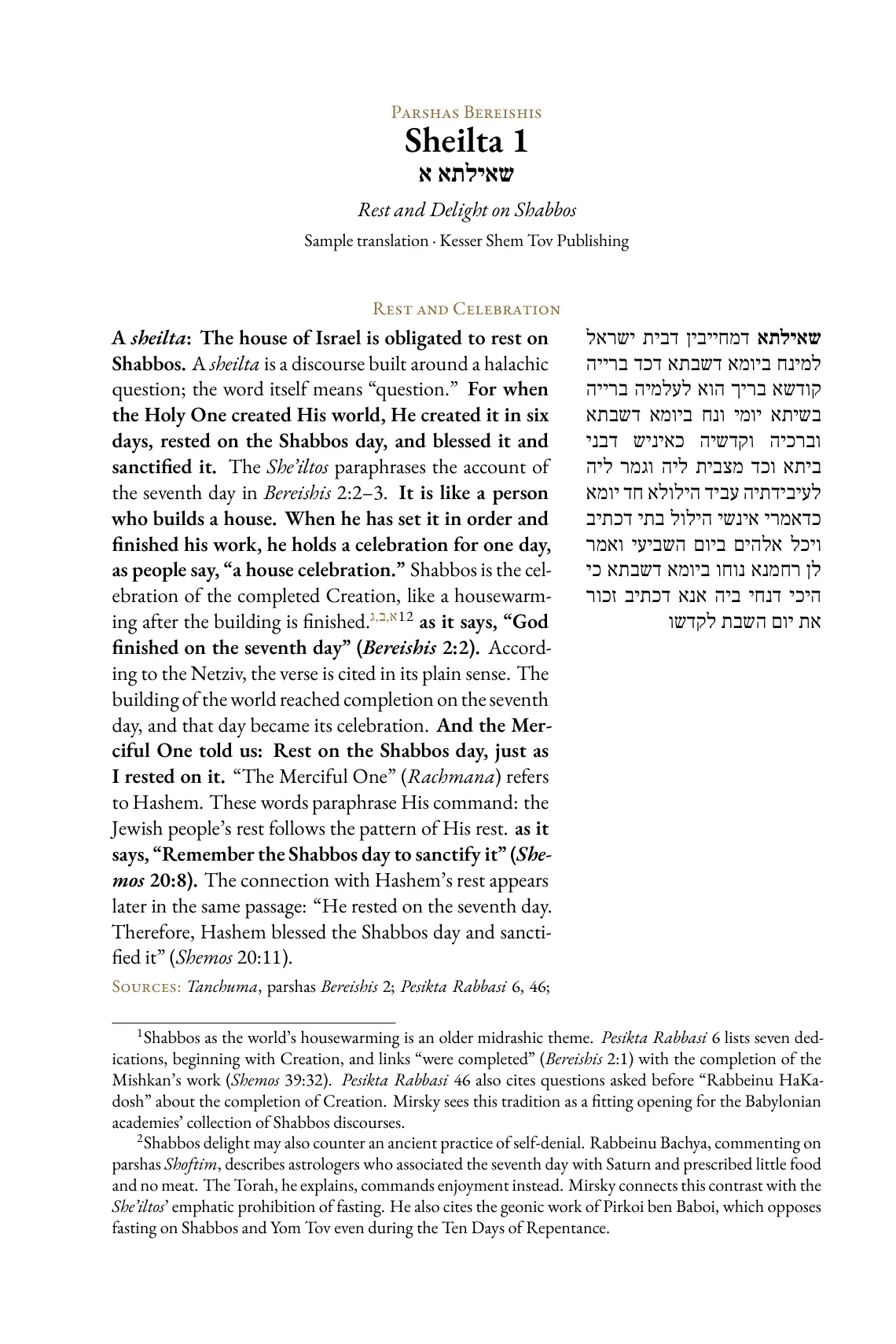
The first Sheilta, on the delight of Shabbos, is read in the sample below.
The edition
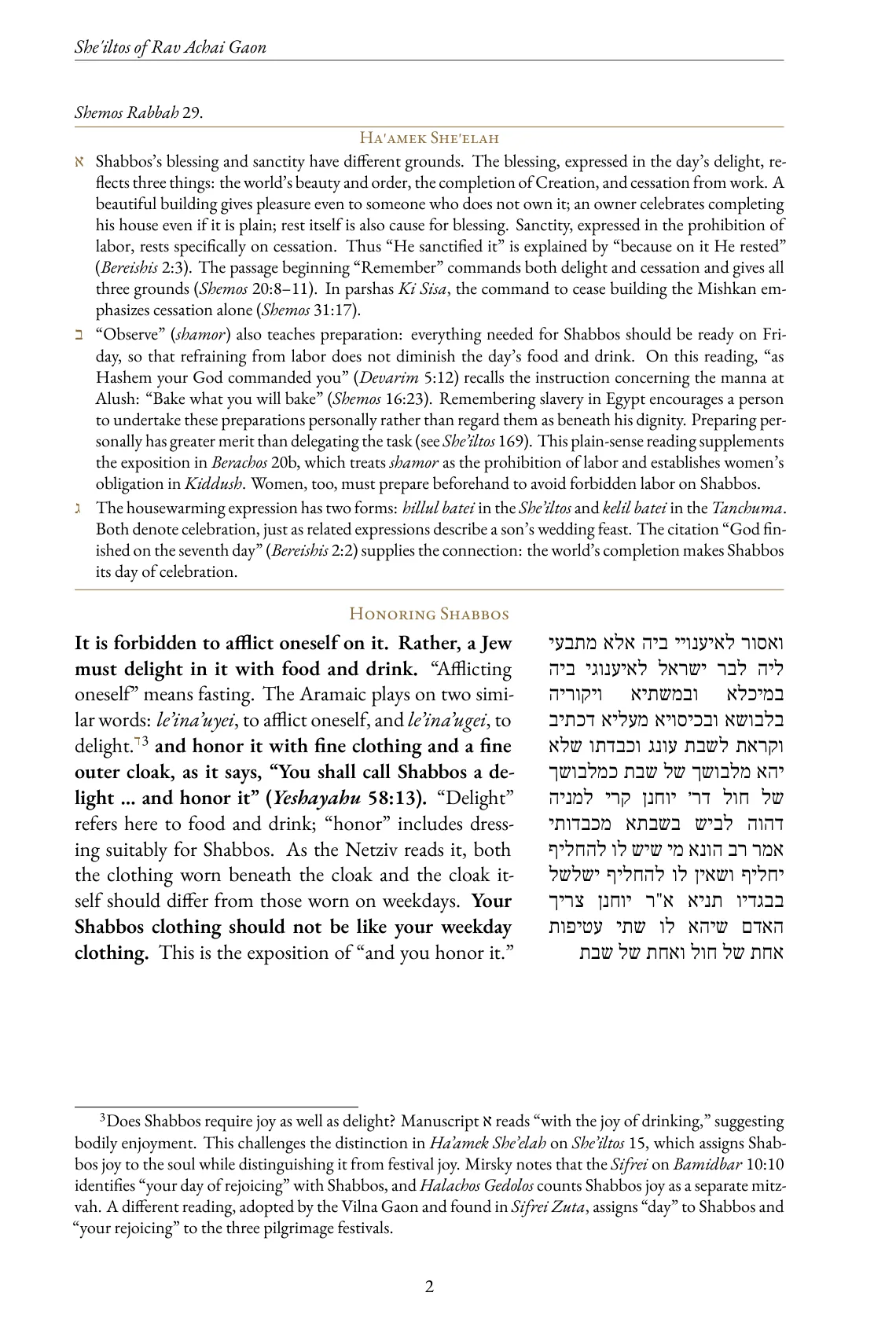
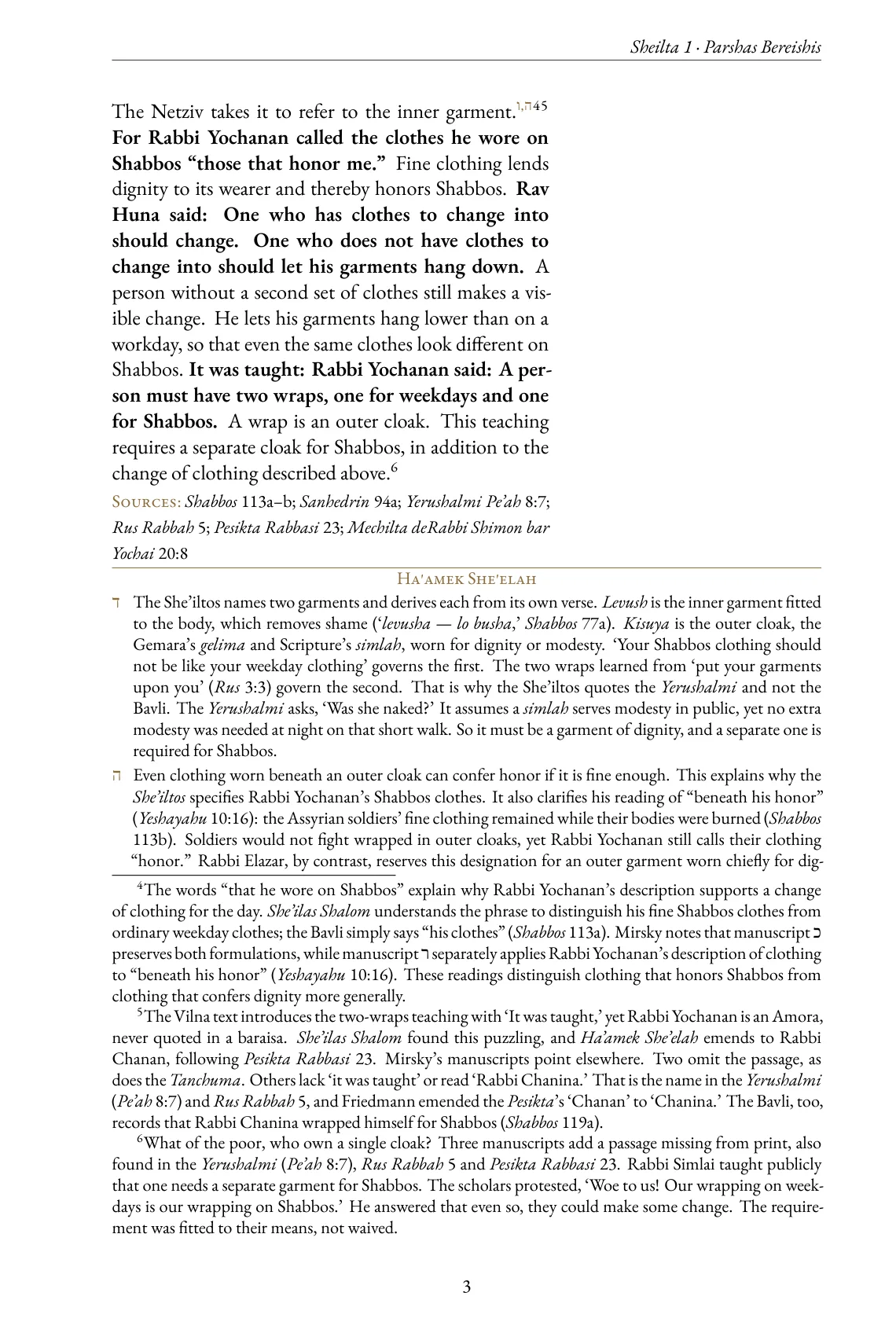
The Hebrew sits in its own column, facing the English phrase by phrase, so the two can be read together or apart.
Each phrase is translated faithfully, then opened in a few clear sentences — one line of thought from the Aramaic to the reader.
The Ha’amek She’elah, summarized after each paragraph it explains and marked as the Netziv’s, so the reader always knows whose voice is speaking.
Footnotes that add something — the parallel in the Gemara, the Rishonim who cite it, the difficulty it answers — with sources gathered in one line at the foot of each paragraph.
The Sheilas Shalom in the footnotes, and the introductions to the Netziv’s commentary — Kidmas HaEmek and Petach HaEmek — translated at the front.
With the Hebrew and English column by column, the work is planned as two volumes — and a patron may carry the name of either, or of both.
See it inside
The sample is the first twelve pages of the first Sheilta: the Hebrew and English in parallel columns, the Netziv’s box, the footnotes and the source lines. It is a working sample — the cover and the front of the book are still to come.
Sponsorship
The family edition
The sefer is published as your family’s edition — your name on the cover banner and title page, with a full dedication plate at the front of every copy, forever.
A share in the sefer
Join a circle of partners who bring the sefer to press together, acknowledged by name on the sponsors’ page of the printed edition.
In honor · in memory
A full dedication page in the front of the sefer — l’ilui nishmas, in honor of a simcha, or in tribute — set in the edition’s own type.
In honor · in memory
A half-page dedication among the tributes at the front of the sefer — a lasting remembrance in a work that will be learned for generations.
Every level is acknowledged in print. Write to us and we will send the dedication options and current amounts for this sefer.
Write to us
Prefer email? Reach us directly at publisher@kstpublishing.com — mention Sheiltos d’Rav Achai Gaon and the dedication you have in mind.